Motivation
SETU Campus 2050 is a catalyst project that investigates SETU’s future spatial development directions. It does so in response to “Project Ireland 2040”, the national long-term strategy “to build a more resilient and sustainable future”, as specified in the revised National Development Plan and the National Planning Framework, also with specific respect to the importance of access to education.
While the National Development Plan is to “secure Ireland’s future, to transform the country, unlock housing, upgrade water and energy infrastructure, … and provide better public transport”, the National Planning Framework (NPF) also outlines “the strategic planning principles and the sustainable development of our urban and rural areas”.
SETU, as a multi-campus-university with several clusters throughout the counties of Waterford, Carlow and Wexford, is an important player among the urban and rural areas in Ireland’s southeast.
How will SETU develop over the next two decades, in line with these directives? What could it look like in the future? Should it not be an exemplar of sustainable development for the region?
In October 2025, “Project Ireland 2040”was complemented by “Future Forty”, Ireland’s economic outlook to 2065”. “Future Forty” discusses future trends and illustrates “the challenges and choices that will shape Ireland’s future” for the next 40 years.
If “Future Forty” can provide an outlook on Ireland’s future until 2065, SETU can create its own and specific vision of what it’s like to experience its campus environment in 2050.
With the national directives at hand and the environmental and societal drivers in mind, SETU Campus 2050 asks:
- How does SETU envisage its campus environments in 2050?
- How will SETU’s campus clusters be connected with and interwoven into their city, their town or their neighbourhoods?
- How will communication, exchange and transport be organised?
- How can SETU establish itself as a living lab showcasing green and blue infrastructures, energy and nature based solutions, interconnected within the wider context?
- What spatial campus experience will students, staff and visitors expect and enjoy?
- Can SETU’s current strategic plan inform the spatial development of its campus clusters?
- What decisions on SETU’s spatial development need to be made now, in order to allow a strong vision to emerge and to be realised in the future?
Objectives and anticipated actions
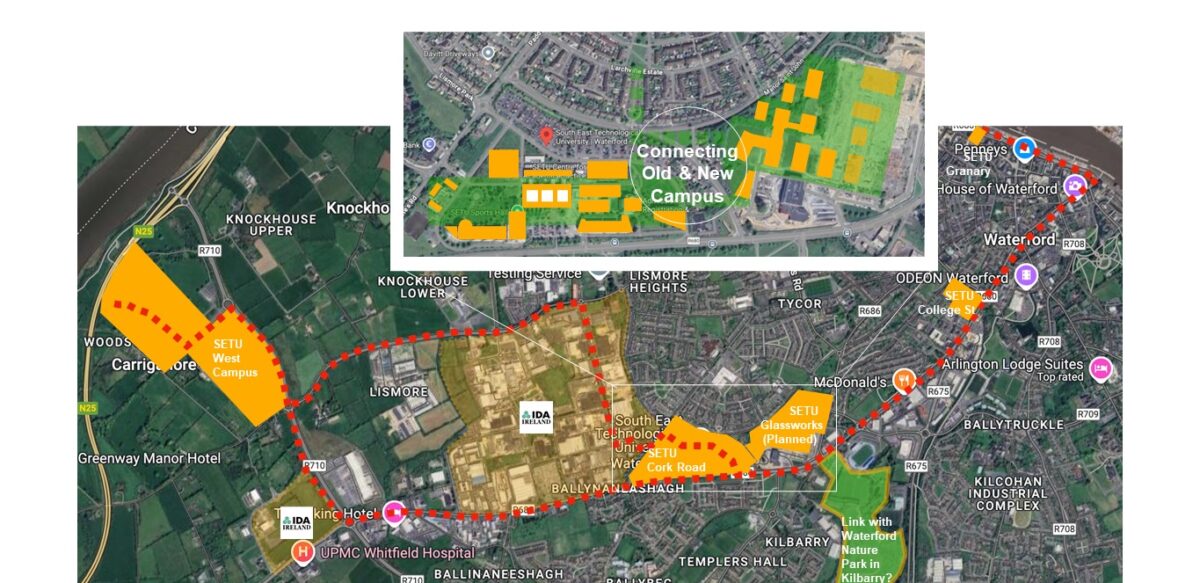
Initially, SETU Campus 2050 will focus on SETU’s Waterford Campus clusters. However, it will then expand to include SETU as a multi-campus-system throughout the region, as far as appropriate and practical, and subject to the project duration.
SETU Campus 2050 is to investigate the following:
- Welcome – SETU’s way to host students, staff, visitors and neighbours
- Connect – SETU’s integration into an advancing public transport and commuting system
- Flow – SETU’s media and communication network
- Open up – SETU’s relationship with neighbourhoods and the city
- Grow – SETU’s increasing portfolio of building premises and campus amenities
- Restore – SETU’s natural (and re-naturalised) environment
- Stimulate – SETU’s campus identity, both within and among its campus clusters
- Vitalise – SETU as an attractive destination within the (sub-)urban context
- Instigate – SETU’s lighthouse projects to push the (spatial) development
- Time – SETU’s schedule for change
- Simulate – SETU’s future development scenarios through data management and virtual immersion (follow up project)
SETU Campus 2050 is to initiate and to sketch a first series of scenarios that show how the campus environment could look like in the future:
- it analyses and visualises processes, strategies and ideas; It maps them in context to each other
- it provides a platform for discussions about SETU’s future development
- it assists in detecting and balancing stakeholder engagement
- it delivers a roadmap for an overall SETU future masterplan, with respect to the national, regional, and local planning frameworks and to SETU’s very own strategic plan
- it informs decisions on alternative routes to be taken during the development process
- it makes a contribution to SETU’s early activation calls such as the “Glassworks” campus extension
- it identifies possible testbeds to drive circular economy, climate change response, nature based solutions and biodiversity net gain
- it triggers new teaching and research projects in the Department of Architecture and Built Environment
- it supports preparing a SETU digital twin project, which is a virtual version of the SETU campus environment, to monitor processes, run simulations, and test “what if” scenarios (Follow up project)
Next Steps / Timeline 2026
Phase 1 – Clarifying the Objectives
- Consultation phase – Identifying goals, strategies, processes, ideas and current projects
- First results to be presented in June 2026
Phase 2 – Synopsis one
- Desktop exercise – Mapping strategies, processes, ideas and current projects in relation to each other
- First results to be presented in September 2026
Phase 3 – Scenarios one
- Desktop exercise and feedback loop – Identifying and visualising different campus development routes and future lighthouse projects for discussion
- First results to be presented in November 2026